Skip to content

Devil’s claw

Harpagophytum procumbens and Harpagophytum zeyheri · grapple plant · the tubers on the sides of the root

In short

  • Part used: the thick tubers that grow out from the sides of the root.
  • Grows: wild in dry Kalahari sand, in Namibia, Botswana and South Africa. Most of it is gathered from the wild.
  • Historical use: wounds and skin, stomach and digestion, fever and cough, pregnancy and childbirth, joints and pain.
  • Can be used for: mild joint pain and mild digestive complaints, according to the EU.
  • Main substances: bitter iridoids, especially harpagoside, and a lot of sugar.
  • The research: many studies, but most are small and old. The reviews disagree on how good they are.
  • Suitable for: adults from 18 with mild joint pain or mild digestive complaints, according to the EU. Not for pregnant or breastfeeding women, or people with stomach ulcers.
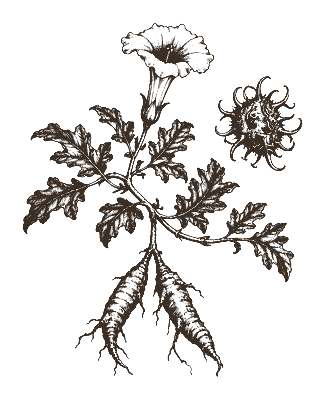
Line drawing of Devil’s claw

An animal that steps on it can starve to death

The medicine is somewhere else.

The fruit looks like a weapon.

It is a woody capsule with two rows of arms, and every arm ends in hooks. The hooks catch in the legs and fur of animals passing by. Sometimes they catch in the mouth and will not let go. Then the animal can starve to death.

A book from 1870 asked the reader to push an arm into a dense rose bush, then imagine the thorns a hundred times more numerous and fifty times larger.

That is why it is called devil’s claw. The Latin name says much the same in Greek: grapple-hook plant.

But the fruit is not the medicine. That lies underground.

The plant

Pretty above ground. Valuable below.

Above ground, devil’s claw looks fairly harmless.

It creeps along the ground and can spread a metre and a half wide. The leaves are greyish green, with three to five lobes. The flowers are shaped like trumpets, in deep velvet red, purple or pink, often with yellow inside.

Underground it has a thick rootstock with a cluster of tubers growing out from the sides. These side tubers are the part used. They hold about twice as much of the substance harpagoside as the main root, and can grow six centimetres thick. Porcupines and antelopes dig them up and eat them.

The plant grows in deep, nutrient-poor Kalahari sand. There are two species, H. procumbens and H. zeyheri, and both are used. Attempts to cultivate it have not gone very well, so most of it is gathered wild. Namibia has exported two thousand tonnes of dried tubers in a single year, which may have taken up to fifty million plants.

The harvesters number in the thousands. Most are women between forty and sixty from very poor rural areas, who walk long distances for little pay.

Before anyone digs, a needle or a button is placed in the sand to buy the tubers from the earth. Without it, the belief goes, you find none.

The wrong plant in the bag

Two species, one label.

Once the tubers are dried and sliced, the two species look exactly alike.

Since the 1970s the trade product has been one species or the other, often mixed. The European Pharmacopoeia accepts both. In the United States, H. zeyheri may not be sold as a herbal supplement.

In 2014 researchers analysed 348 wild samples. Only four in ten samples of H. procumbens and fewer than two in ten of H. zeyheri contained as much harpagoside as the pharmacopoeia requires. The researchers concluded that the species are not chemically equivalent and should not be substituted for each other.

In 2021 researchers tested supplements bought in the United States. Twenty of them could be analysed. Three in four contained no H. procumbens at all. None contained only H. procumbens.

Sometimes main roots low in harpagoside are mixed in as well, or roots of entirely different bitter plants.

Historical use

Wounds first. Then the stomach. The joints came last.

So who used the tubers first, and for what?

Devil’s claw belongs to southern Africa, and the story begins there. The order is not a ranking. The early sources do not distinguish between the two species.

Wounds and skin

  • Namibia, 1901: the tubers were used to heal wounds. This is the first reliable description of the use.
  • Southern Africa, 1932: ointment of fresh tuber on wounds and boils, and even on tumours on the outside of the body.
  • Southern Africa, undated: dry powder laid on wounds as a dressing.
  • Disagreement: local users in Namibia believe, according to a book from 2001, that root tea that is too strong or taken too often can cause cancer, kidney damage or arthritis.

Stomach and digestion

  • Namibia, 1907: the Herero man Samuel Kariko told a German military doctor that the tubers were used for diarrhoea and constipation.
  • Southern Africa, 1932: taken by mouth, the tuber is said to act as a laxative.
  • Southern Africa, undated: roasted tubers were eaten or boiled into a decoction for stomach trouble.
  • Germany, 1989: for loss of appetite and poor digestion.
  • Europe: the EU’s expert committee writes that use for digestion is the oldest known in Europe. Use for the joints is more recent.
  • Disagreement: SEPASAL writes that the use for digestive complaints in South Africa and Europe has no clinical or scientific basis.

Fever, cough and infections

  • Namibia, 1907: for cough and venereal disease, according to Samuel Kariko.
  • Southern Africa, 1932: tea of the tuber for all kinds of fever.
  • Southern Africa, undated: for infectious diseases, syphilis and gonorrhoea.

Pregnancy and childbirth

  • Southern Africa, 1932: dried and powdered tuber was given to pregnant women for pain, and continued after the birth. Women expecting a difficult birth had ointment of fresh tuber rubbed on the belly.
  • Southern Africa, undated: as an aid in childbirth.
  • Disagreement: PlantZAfrica writes that high doses can cause abortion. SEPASAL writes that the claim that it causes abortion has largely been disproved.

Joints and pain

  • Southern Africa, undated: for pain.
  • Germany, 1958: the first laboratory experiments.
  • Germany, 1989: as supportive treatment for degenerative disorders of the joints and muscles.
  • The West, 2006: used mostly for arthritis and rheumatism.
  • Disagreement: Brendler considers it highly doubtful that the plant material in the 1958 experiments was actually devil’s claw.

It is often said that people in the Kalahari have used devil’s claw for joint pain for generations. The oldest African sources on this page, from 1901, 1907 and 1932, say nothing about joints.

Many texts also tell how a German soldier during the war in Namibia from 1904 to 1908 saw a local healer help a badly injured man, and found the plant with the help of his dog. PlantZAfrica writes that he learned about the plant from the San and Nama peoples. Brendler calls the story romance and part of a marketing campaign. The credit, he writes, belongs first and foremost to the peoples who used it.

Can be used for

Joints and stomach, on long tradition.

The authorities have included both the joints and the stomach.

  • EU: mild joint pain, and mild digestive complaints such as bloating and flatulence, and temporary loss of appetite. Approved only on the basis of long-standing use. The expert committee considers the clinical data insufficient for anything more.
  • Norway: as a traditional herbal medicinal product to relieve mild joint pain and digestive disorders such as bloating, flatulence and temporary loss of appetite.
  • Germany: loss of appetite, poor digestion and as supportive treatment for degenerative disorders of the locomotor system.
  • World Health Organization: pain in rheumatic conditions, and here the organisation considers the use supported by clinical data. The pharmacopoeias also list loss of appetite, digestive complaints, osteoarthritis and tendinitis.
  • Canada: as a bitter to stimulate appetite, for indigestion, and for joint pain in osteoarthritis.

So the World Health Organization and the EU reach different answers on whether the studies hold up.

Who it suits

For stiff joints and a sluggish stomach. Not for a sore stomach.

The tubers are approved for the joints and digestion. But who do they suit?

Who can use it

  • The authorities: adults from 18, say the EU, Norway and Canada.
  • Herbalists: the American herbalist Michael Moore mentions people with inflamed joints, arthritis and rheumatism.
  • Experience: rolv.no writes that many rheumatic complaints are linked to poor digestion, and that the bitter root can help with both. The site also mentions gout.
  • Research: most studies have been done in adults with osteoarthritis of the knee or hip, and in adults with long-term back pain.

Who it doesn’t suit

  • Pregnant and breastfeeding women: the EU, Norway and the WHO advise against it, because there isn’t enough knowledge. rolv.no writes that the root can make the womb contract. Canada says: ask a health professional first.
  • Children and teenagers under 18: the EU, Norway and Canada advise against it, because knowledge is lacking.
  • Stomach and duodenal ulcers: the WHO, Commission E, rolv.no and PlantZAfrica say no. The EU says no with an active ulcer. The bitter substances increase stomach acid. Taiwan requires the same warning on tea made from the leaf.
  • Gallstones: the EU, Norway, the WHO and Commission E say: talk to a doctor first.
  • Heart problems: rolv.no advises against it, because the root can lower blood pressure and pulse. PlantZAfrica writes that very high doses can work against blood pressure and heart medicines.
  • Diabetes: PlantZAfrica says no.
  • Blood thinners: the EU’s expert committee refers to one case of bleeding in the skin in someone taking warfarin.
  • Joint pain with swelling, redness or fever: the EU says a doctor should examine it first.

Where the sources disagree

  • Canada: lists no groups who should avoid it, not even with stomach ulcers or gallstones.
  • Pregnancy: in South Africa the tuber was given to pregnant women for pain, according to a book from 1932. PlantZAfrica also mentions pain in pregnant women. Moore does not mark it as unsuitable in pregnancy. The authorities advise against it.
  • Bile: the EU’s expert committee wrote in 2008 that it has not been shown that the root increases bile. The gallstone warning was still added in 2016.
  • Anti-inflammatory medicines: Moore writes that the root seems to combine well with such medicines, allowing a lower dose.
  • Age: a review from 2025 found that six in ten medicines with devil’s claw gave use from age 12. The EU says from 18.

What’s in the plant

One of the bitterest roots there is. And half sugar.

What is in the tubers?

  • Iridoids: bitter substances. A decoction of the root is one of the strongest bitters known.
  • Harpagoside: the iridoid that gets measured. The pharmacopoeia requires at least 1.2 per cent in the dried root.
  • Harpagide: a related iridoid. In a skin experiment it raised an inflammatory enzyme that harpagoside lowered.
  • 8-coumaroylharpagide: found in H. zeyheri, but hardly at all in H. procumbens. It is one of the differences between the species.
  • Verbascoside: another substance from the tuber, which dampened the same inflammatory enzyme, but more weakly.
  • Sugar: about half of the dried root, mostly stachyose.

Which substance works?

The pharmacopoeia has made up its mind. The researchers have not.

The pharmacopoeia measures harpagoside. The question is whether harpagoside is what works.

The EU’s expert committee writes that it is unclear whether harpagoside is behind the pain-relieving effect, and that the effect is attributed to the whole extract.

In 2001 an extract of the root stopped human immune cells from making the inflammatory substance TNF-alpha. Harpagoside and harpagide on their own did nothing.

In 2004 researchers tested extracts on kidney cells from rats. An extract without harpagoside worked too. Pure harpagoside worked only in amounts far above what was present in the extracts that worked.

In 2008 the substances were tested one by one on pig skin. Harpagoside and 8-coumaroylharpagide dampened the inflammatory enzyme. Harpagide raised it. The researchers concluded that the effect depends on the balance between the substances, and that this fits poorly with official standards that measure harpagoside alone.

An experiment in human blood from 2001 pulls a little the other way. There, fractions of the extract without harpagoside hardly worked. But the whole extract worked more strongly than pure harpagoside.

The pharmacopoeia has chosen one substance to measure. None of the experiments here found that this substance does the job alone.

What the research says

Same studies. Two different verdicts.

What happens when people with painful joints and painful backs are given devil’s claw?

In 2000, 122 people with osteoarthritis of the knee or hip were given either whole root powder or the drug diacerein for four months. Both groups improved, and the pain improved equally. The root powder group used fewer painkillers and had fewer side effects. Diarrhoea affected fewer than one in ten on root powder, against more than one in four on diacerein. The first author was employed by the company that makes the powder. The EU’s expert committee writes in the same report both that the treatments were equally good, and that devil’s claw was weaker.

In 1999, 197 people with a flare-up of long-term back pain were given either extract in two strengths or a placebo for four weeks. In the last week, three were pain-free on placebo, six on the low dose and ten on the high dose. The EU’s expert committee points out that the extract is not available to buy, and that no clear conclusion could be drawn.

Cochrane reviewed the back pain studies in 2006 and found strong evidence from two high-quality studies. In 2014 Cochrane reviewed the same studies again. This time they called the evidence weak, and wrote that devil’s claw may be better than placebo.

A review from 2025 found that most of the studies are of poor quality, that none lasted more than twelve weeks, and that almost nine in ten are more than twenty years old. The review also found signs that studies with positive results are more likely to be published.

Questions people ask

Does it work like an anti-inflammatory tablet?

The sources disagree.

In 1992, 25 healthy people took root powder for three weeks. The researchers found none of the changes in the blood that ordinary anti-inflammatory tablets cause.

In 2001 healthy men were given extract, and the level of the inflammatory substance leukotriene in their blood fell.

And in the study from 2000, those given the root powder needed fewer such tablets.

The cows got the hooks. We got the tubers.

Sources

Authorities and monographs

  • EMA/HMPC, EU monograph on Harpagophytum procumbens and/or H. zeyheri, radix, 2016. ema.europa.eu
  • EMA/HMPC, assessment report on Harpagophytum procumbens and/or H. zeyheri, radix, 2016. ema.europa.eu
  • Commission E, devil’s claw root, 1989/1990. herbalgram.org
  • WHO Monographs on Selected Medicinal Plants, vol. 3, 2007, Radix Harpagophyti. iris.who.int
  • Health Canada, monograph on devil’s claw, 2026. canada.ca
  • Felleskatalogen (Norwegian medicines reference), Giduxa. felleskatalogen.no
  • Taiwan Ministry of Health and Welfare, draft rules for eight food ingredients, devil’s claw among them, 2023. mohw.gov.tw

Tradition and the plant

  • Brendler 2021, review of devil’s claw from tradition to medicine (quotes Wood 1870, Lübbert 1901, Hellwig 1907 and Zorn 1958). Europe PMC
  • Watt and Breyer-Brandwijk, Medicinal and Poisonous Plants of Southern Africa, 1932. archive.org
  • PlantZAfrica (SANBI), Harpagophytum procumbens, 2006 (quotes von Koenen 2001). pza.sanbi.org
  • PROTA4U, Harpagophytum procumbens (quotes SEPASAL). prota4u.org
  • Moore, Herbal Tinctures in Clinical Practice, 3rd ed. 1996. swsbm.com
  • Moore, Herbal Materia Medica, 5th ed. 1995. swsbm.com
  • Urtekilden (Norwegian herb site), devil’s claw. rolv.no

Adulteration

  • Mncwangi et al. 2014 (348 wild samples). Europe PMC
  • Diaz-Silveira et al. 2021 (DNA testing of supplements). Europe PMC

Research

  • Fiebich et al. 2001 (immune cells). Europe PMC
  • Kaszkin et al. 2004 (kidney cells). Europe PMC
  • Abdelouahab and Heard 2008 (skin). Europe PMC
  • Loew et al. 2001 (human blood). Europe PMC
  • Moussard et al. 1992 (healthy volunteers). Europe PMC
  • Leblan et al. 2000 (root powder and diacerein). Europe PMC
  • Chantre et al. 2000 (same study). Europe PMC
  • Chrubasik et al. 1999 (back pain). Europe PMC
  • Gagnier et al. 2006, Cochrane (back pain). Europe PMC
  • Oltean et al. 2014, Cochrane (back pain). Europe PMC
  • Bargsten and Seifert 2025 (review of studies and products). Europe PMC