
Skip to content

Elder

Sambucus nigra · black elder · the berries

In short

  • Part used: the ripe berries, most often as juice, syrup, wine or dried. The flowers, bark and leaves have also been used, but have their own history.
  • Grows: wild in Europe, Asia and North Africa, according to rolv.no. It came to Norway as a cultivated plant in the early Middle Ages or before, and grows mostly near gardens and old crofts.
  • Historical use: laxative and diuretic, womb and menstruation, hair and ears, colds and fever, nerve pain and sciatica, rheumatism, stomach and gut, strength and long life, belief and magic.
  • Can be used for: traditionally to promote sweating in fever, for colds and flu, joint pain and as a diuretic, according to Canada. The EU has no monograph for the berry.
  • Main substances: anthocyanins, which give the dark colour, flavonoids, vitamin C, fruit acids and tannins. The stones contain small amounts of substances that can release hydrogen cyanide.
  • The research: some small studies found faster recovery from flu, and several were paid for by the manufacturers. A study in the USA, paid for by a hospital and a foundation, found no effect.
  • Suitable for: the EU does not recommend it under 18 years. Canada accepts children from 2 years. Not recommended for pregnant or breastfeeding women. Unripe berries, leaves and stalks should not be eaten.
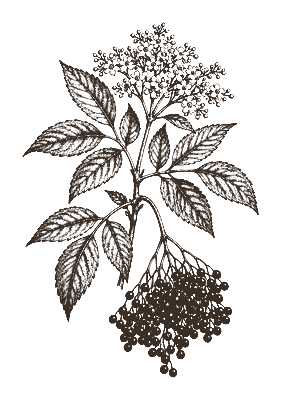
Line drawing of Elder

The port that was not port.

A mistake in the glass became a cure.

In Prague the physician Epstein had given a patient port wine as a tonic. He was surprised at how well the wine relieved the patient’s nerve pain. Then it turned out that it was not port, but wine coloured with elderberry juice, writes Madaus.

Epstein tried pure elderberry juice on 48 patients with long-standing pain in the facial nerve. The results were “erstaunlich”, astonishing, wrote Madaus. His colleague Jokel tried the same and got the same result. The trial was published in 1914.

Grieve tells another version: in 1899 an American sailor told a physician in Prague that getting drunk on dark-red port was a sure cure for rheumatic pains. It turned out that it was the cheap port, coloured with elderberry juice, that took away the pain of sciatica and other nerve pain.

In Norway the physician Vetlesen tried the juice for sciatica in 1916. In 1917 an advertisement in Akers-Posten said: “Hyldebærsaft har i de senere aar været sterkt anbefalet som et udmerket middel mot gigt og ischias”, elderberry juice has in recent years been strongly recommended as an excellent remedy for rheumatism and sciatica.

The plant

A shrub with white umbels and black clusters.

Elder is a shrub or small tree that can grow up to 7 metres tall, writes rolv.no. Helsenorge gives 2 to 8 metres. The bark on older stems is grey-brown and cracked and has an unpleasant smell. The leaves sit in pairs and are divided into 5 to 7 pointed leaflets.

In June and July yellowish-white flowers appear in flat umbels, up to 20 centimetres across, with a strong scent. In September the blue-black berries ripen in large clusters, and the cluster bends down under the weight, writes rolv.no. Each berry is around half a centimetre, usually has three small stones and tastes sweet and sour, writes the EU report.

rolv.no calls them berry-like drupes, but in everyday language they are called berries.

The name nigra means black and refers to the berries, writes Madaus. Where Sambucus comes from is not certain, writes Madaus. Grieve writes that the name comes from the Greek word sambuca, a stringed instrument the Romans used. The English name elder comes from an Anglo-Saxon word for fire, because the hollow branches were used to blow up a fire, writes Grieve.

In Norway elder is not originally wild. It came as a cultivated plant in the early Middle Ages or before, writes rolv.no. If you find an elder tree in the wild, it probably stands where there was once a croft. Naturalised trees are found in coastal areas from Oslo to Møre og Romsdal.

The wrong plant in the bag

Not every elder is black elder.

Is there black elder in the bag?

Grieve and Madaus warn against dwarf elder. It looks like black elder, but is a herb that dies back to the ground every year, writes Grieve. Grieve writes that it seldom grows taller than a metre, while Madaus gives 50 to 200 centimetres. Dwarf elder berries were often found among dried elderberries from the Continent, wrote Grieve in 1931. Madaus writes, after Geßner, that the black berries of dwarf elder have caused fatal poisonings in children.

Reichborn-Kjennerud listed black elder and two other elder species, among them dwarf elder, under the same name, hyll, in 1922. The name skogshyll, forest elder, belonged to a quite different plant, guelder rose.

In North America American elder is used in the same way as black elder in Europe, writes rolv.no. King’s American Dispensatory wrote in 1898 that the two plants have similar medicinal properties.

The elderberries were themselves used to adulterate. Grieve writes that the juice was used to colour raisin wine and to adulterate foreign wines, and that cheap port was often made to resemble tawny port with elderberry juice.

Ripeness also matters. Unripe berries contain toxic substances and should be avoided, writes the EU report.

Historical use

From laxatives and the womb to sweating and nerve pain.

Who used elder, and for what?

Elder has been used almost from root to tip. Ettmüller called it “the medicine chest of the country people”, writes Grieve. It is said that the physician Boerhaave raised his hat every time he passed an elder tree. Already the Hippocratic writings described elder as laxative, diuretic and a remedy for women, writes Madaus. Hildegard of Bingen, on the other hand, thought that the tree and its fruit were of little use to people.

Only what the sources say about the berries is given here. The oldest sources use them mostly for dropsy and complaints of the womb. For colds, the oldest dated source is from 1773, but Grieve writes that elderberry rob has been made for colds and coughs “almost from time immemorial”. In North America the use mostly concerns American elder. The order is not a ranking.

Laxative and diuretic

  • England, 17th century: Culpeper wrote that the berries, green or dried, were often given with good success for dropsy, and that a decoction of the berries in wine provokes urine. Rob of elderberries, juice boiled thick, was meant to “gently purge the watery humour”.
  • England, Gerard: the dried seeds in the berries are good for dropsy and for those who are too fat and would like to be leaner, as quoted by Grieve.
  • England, 1773: Brookes recommended elderberry rob because it promotes stool, urine and sweat, as quoted by Grieve. Grieve writes that the berries are laxative, diuretic and emetic.
  • Germany: Bohn wrote that the berries stimulate the kidneys, writes Madaus.
  • Ukraine, Poland and Czechia: a tea of the berries as a laxative in Ukraine, fresh berries as a laxative in Poland, and a syrup of the berries as a laxative in Czechia, writes Madaus. Hämmerle used dried berries for constipation.
  • North America, 1898: King’s American Dispensatory: the juice evaporated to a syrup is laxative and alterative.
  • North America: the Micmac used berries, bark and flower as a purgative, according to the American database of Indigenous plant use, NAEB.

Womb and menstruation

  • Greece, around AD 50–70: Dioscorides wrote about black elder and dwarf elder together, because they have the same properties. A bath of the plant softens the womb and sets right complaints around it, and a decoction of the fruit drunk with wine does the same.
  • England, 17th century: Culpeper wrote that the berries boiled in wine soften the womb, open the veins and bring on menstruation.
  • Norway, Hurum: for morsyke, that is complaints of the womb, people made a drink of castoreum, camphor and elderberries, boiled with French brandy for two hours, wrote Reichborn-Kjennerud.
  • Childbirth: we found no sources that describe use of the berries in childbirth.

Hair, ears and skin

  • Greece, around AD 50–70: Dioscorides wrote that the fruit rubbed on makes the hair dark.
  • Rome: the Romans used elderberry juice as a hair dye, writes Grieve.
  • England, 17th century: Culpeper wrote that the hair becomes black when washed with berries boiled in wine, and that juice of the berries boiled with honey and dropped into the ear helps against earache.
  • England: our forefathers held the berries to help against erysipelas, a skin infection, writes Grieve.

Colds, fever and sweating

  • Germany, around 1150: for jaundice Hildegard of Bingen recommended a sweat bath with the leaves. The same chapter says that the fruit can be taken in warm wine, so that the body is also warmed from within.
  • England, 1773 and 1788: Brookes recommended elderberry rob mixed with water for common colds. The rob was in the pharmacopoeia in England, was renamed in 1788 and disappeared from it in 1809, writes Grieve.
  • England, 1931: Grieve wrote that elderberry wine, drunk hot at night, promotes sweating in the early stages of a severe cold, and that it is “one of the best preventives known against the advance of influenza”. The syrup was “an excellent cure for a cold”.
  • Lithuania: a tea of the flowers, bark and fruit as a sweat-inducing remedy and to regulate digestion, writes Madaus.
  • Norway: a tea of the berries is also known as a sweating remedy, wrote Reichborn-Kjennerud in 1922.
  • North America: the Iroquois used the berries for fever and for swellings in mumps, according to NAEB.

Nerve pain and sciatica

  • Prague, 1914: the physicians Epstein and Jokel gave elderberry juice to patients with pain in the facial nerve. A little alcohol in the juice improved the effect, writes Madaus. rolv.no writes that the attacks subsided after 10 to 14 minutes.
  • Norway, 1916: the physician Vetlesen gave elderberry juice and port wine to 13 patients with sciatica, and saw very good results, writes Madaus.
  • Czechoslovakia, 1936: Müller also gave the juice for pain in the facial nerve, including to patients who had tried all painkillers, writes Madaus.
  • Germany, 1938: Madaus writes that the juice was “sehr gelobt”, highly praised, for nerve pain, and that it was also used for ear and tooth pain, nightmares and heart complaints.

Rheumatism and gout

  • England: our forefathers held the berries to help against rheumatism, and the inspissated juice has been used for rheumatism and syphilis, writes Grieve.
  • North America, 1898: King’s American Dispensatory: the flowers and the juice of the berries have been used with good results for scrofula, skin diseases, syphilis and rheumatism.
  • North America: the Cherokee drank a tea of the berries for rheumatism, and the Rappahannock drank a fermented decoction of the berries for rheumatism, according to NAEB.
  • Experience, rolv.no: the berries have been used for rheumatism and gout.

Stomach and gut

  • Czechia: people boiled the fruit for diseases of the stomach and throat, and a fruit spread was meant to stop diarrhoea, writes Madaus.
  • England, 1931: Grieve: a tea of dried berries is said to be a good remedy for colic and diarrhoea.
  • Experience, rolv.no: a tea of dried berries for colic and diarrhoea.

Strength, long life and epilepsy

  • England, 17th century: the writer Evelyn wrote that an extract of the berries greatly assists longevity, as quoted by Grieve.
  • Europe, 1644: the book The Anatomie of the Elder stated that the berries of elder and herb Paris help against epilepsy, writes Grieve.
  • North America: the Houma drank wine made from the berries as a tonic, and the Iroquois gave the berries to people who were convalescing, according to NAEB.

Belief and magic

  • Norway: elder was a sacred tree, a farmyard or guardian-spirit tree, and in folk belief the good spirit of the family that protects health and happiness, wrote Reichborn-Kjennerud. Paracelsus recommended elder as a toothache tree.
  • Denmark: in the branches lived Hylde-Moer, the Elder Mother. Anyone who wanted to cut the tree had to ask permission first, writes Grieve.
  • England: in the Middle Ages people believed that Judas hanged himself on an elder tree. People fixed elder leaves to doors and windows to keep witches out, writes Grieve.
  • Styria: elderberries gathered on St John’s night were to be used in a magic circle, writes Grieve.

Africa

  • Africa: PROTA writes that elder has been introduced and is grown in hedges in, among other places, Ghana, Gabon, Kenya, Tanzania and Ethiopia. In Gabon the flowers are used in a skin ointment and to promote sweating. We found no African use of the berries.

China

  • China: ShennongAlpha, which reproduces Chinese drug standards, includes black elder among Chinese medicinal plants, but only the stem and leaves, together with other elder species. They are used for rheumatic pain, gout, fractures and kidney inflammation. We found no Chinese use of the berries.

Can be used for

Colds, fever and joints. On tradition.

What do the authorities say?

  • EU: no monograph for the berry. The EU writes that information on dose and strength in the traditional use is missing.
  • Germany: Commission E has only a monograph for the flower, for colds. The berry has none.
  • WHO: the monograph concerns the flower, not the berry.
  • Canada: traditionally to promote sweating and relieve fever in colds and flu, for symptoms of colds and flu such as cough, sore throat and mucus, for joint pain such as in arthritis, and as a diuretic. Canada also accepts the berry as a source of antioxidants.
  • Experience: rolv.no mentions colds and flu, cold sores, nerve pain in the face, colic and diarrhoea, rheumatism and gout. PROTA writes that extracts of the berries are today used mostly against viruses, in colds, flu and herpes.

Of the authorities we checked, only Canada has an official text for the berry.

Who it suits

Adults. Ripe berries only.

The berry is used for colds and flu. But who does it suit?

Who can use it

  • The authorities: the EU has no monograph for the berry, but does not recommend it under 18 years. Canada accepts adults, children from 2 years and adolescents, for fever and colds.
  • Experience: rolv.no writes that it is better to use the juice than to eat whole, fresh berries.
  • Research: most studies have been done on adults. One study gave the syrup to children from 5 years. Women who took an elderberry extract for 12 weeks had normal liver and kidney values.

Who it doesn’t suit

  • Pregnant and breastfeeding women: the EU writes that safety has not been shown. Memorial Sloan Kettering Cancer Center in the USA says: avoid, because of the risk of toxicity and stomach upset. Canada says: ask a health professional first. rolv.no writes that the manufacturer of the syrup Sambucol advises against use in pregnancy.
  • Children and adolescents under 18 years: the EU does not recommend it, because data are lacking.
  • Allergy: Canada says: stop if allergy occurs. An Austrian study found that 0.6 per cent of 3,668 patients tested for allergy reacted to elder, and that the same allergen is found in pollen, flowers and berries.
  • Immunosuppressants and corticosteroids: the EU writes that elderberry could in theory affect the treatment.
  • Diabetes medicines, diuretics and laxatives: Memorial Sloan Kettering writes that elderberry may add to their effect, but that it is not clear whether this matters in practice.
  • Unripe berries, leaves and stalks: can cause stomach upset, write Helsenorge and rolv.no. The EU report writes that unripe berries contain substances that can release hydrogen cyanide.

Where the sources disagree

  • Age: the EU does not recommend it under 18 years. Canada accepts children from 2 years. The American study from 2020 gave the syrup to children from 5 years.
  • Pregnancy and breastfeeding: the EU is cautious, and Memorial Sloan Kettering says avoid. LactMed writes that cooked berries do not carry the cyanide risk, but that there are no data on breast milk, and that no recommendation can be made. NCCIH in the USA says that little is known.
  • Raw, ripe berries: Helsenorge writes that ripe berries are regarded as harmless, but that large amounts can cause stomach upset. rolv.no writes that raw berries can cause nausea and vomiting, probably because of substances in the stones. PROTA writes that the berries are best not eaten raw, because they are mildly poisonous. The EU report writes that the berries are safe when ripe, cooked or dried.
  • The immune system: in cell experiments, elderberry preparations increased inflammatory substances. Mice given such a preparation before and after infection with malaria more often got malaria in the brain. A review from 2021 found no sign that elderberry overstimulates the immune system in humans.

What’s in the plant

Colour in the berry. Cyanide in the stone.

What is in the berries?

  • Anthocyanins: the pigments that make the berries dark. The EU report gives 1 to 8 milligrams per gram of fresh berries. About two thirds are cyanidin-3-glucoside and one third cyanidin-3-sambubioside.
  • Flavonoids: rutin, isoquercitrin and hyperoside, according to rolv.no.
  • Vitamin C: the EU report gives 18 to 26 milligrams per 100 grams of fresh berries. rolv.no gives 100 milligrams per kilo, which is less.
  • Sugar and fruit acids: up to 7.5 per cent sugar (the EU report), and citric, malic and tartaric acid (rolv.no).
  • Tannins and minerals: 3 per cent tannins and zinc (rolv.no), and potassium (the EU report).
  • Essential oil: only around 0.01 per cent, writes the EU report.
  • Lectins: dried seeds contain 0.1 per cent, writes the EU report.
  • Sambunigrin: a substance that can release hydrogen cyanide. The EU report gives 3 milligrams of hydrogen cyanide per 100 grams of berries, and 3 to 17 milligrams per 100 grams of leaves. In American elder there was most in the stalks and the green berries, and no measurable trace in juice from the shop.

Processing matters a lot. Slovenian researchers found in 2016 that heat lowered the cyanide-forming substances by 44 per cent in juice, 80 per cent in tea and 96 per cent in liqueur and spread. Heat also lowered the phenolics, to which the pigments belong.

Which substance works?

The pigments or something else? Nobody knows for sure.

Many substances. Which one does something?

rolv.no writes that zinc, vitamin C and anthocyanins make elderberry known for strengthening the immune system.

In cell experiments, flavonoids from elderberry bound to influenza viruses and prevented them from infecting the cells, found researchers at the company HerbalScience Group in 2009. Israeli researchers found in 1995 that an elderberry extract inhibited several types of influenza virus in cells.

Japanese researchers at the company Kikkoman found in 2012 that the juice worked weakly against virus in cells, but better in mice. They believed that large sugar molecules in the juice strengthened the immune system.

We found no study in humans that separates the substances from each other.

What the research says

Positive small studies. One without a manufacturer found nothing.

What happens when people actually take elderberry?

In 1993 people on a kibbutz in Israel got influenza B. Those who were given the elderberry syrup Sambucol recovered faster: 93 per cent were better within two days, while most of those on placebo needed six days. In Norway 60 adults with flu-like symptoms were followed in the winter of 1999–2000. Those given the same syrup got better on average four days earlier. The EU writes that the Norwegian study was paid for by the manufacturer.

In Australia 312 air passengers were given capsules with elderberry or placebo. There were not clearly fewer colds, 12 against 17, but the colds lasted shorter and were milder. The study was paid for by the company Iprona, which supplied the capsules and helped plan the study.

In the USA 87 people from 5 years with confirmed influenza were given the same syrup or placebo for five days. There was no difference. An analysis done afterwards suggested that those who took the syrup without flu medicine were ill about two days longer than those who took placebo without flu medicine. The study was paid for by Cleveland Clinic and a family foundation.

Two studies looked at the heart. 34 young adults were given an elderberry powder for two weeks, and cholesterol hardly changed. 52 women after menopause were given an extract for 12 weeks, and the markers for heart and blood vessels did not change.

A meta-analysis from 2019 found large effects against colds and flu, but it was paid for by the Franklin Institute of Wellness, where the authors worked. A review from 2020 wrote that the berries may make colds and flu shorter if taken within 48 hours. A review from 2021, paid for by the American health authorities, wrote that elderberry may not lead to fewer colds, and that it is uncertain whether it shortens the illness. The EU writes that two studies suggest faster recovery from flu, but that more studies are needed.

In short: the small studies were positive, and several were paid for by the manufacturers. The study from the USA, which was not paid for by the manufacturer, found nothing with the same syrup.

Questions people ask

Are raw elderberries poisonous?

Unripe berries are. On ripe berries the sources disagree.

The EU report writes that unripe berries should be avoided, and that the berries are safe when ripe, cooked or dried. Helsenorge regards ripe berries as harmless. rolv.no and PROTA write that raw berries can cause nausea and vomiting. In California 11 of 25 people became ill in 1983 after drinking juice in which the berries had been pressed together with leaves and branches. One was admitted to hospital, but the level of cyanide in the blood was normal. The tree was a wild elder species from the western USA.

Does elderberry help against flu?

The studies point in different directions.

Two small studies found faster recovery, but the Norwegian one was paid for by the manufacturer. The study from the USA, which was not paid for by the manufacturer, found no difference. The EU says that more studies are needed.

Can children use elderberry?

The sources disagree.

The EU does not recommend it under 18 years. Canada accepts children from 2 years. The poison information centre in Erfurt in Germany received 295 enquiries about elder from 2010 to 2019. None concerned serious poisoning. The figure does not separate children from adults.

Can elderberry overstimulate the immune system?

It has not been shown in humans.

In cell experiments, elderberry preparations increased inflammatory substances. A review from 2021 found no sign of overstimulation in humans. The EU writes that elderberry could in theory affect immunosuppressive treatment.

Are the flower and the berry the same?

No.

Commission E and the WHO have monographs only for the flower, for colds. rolv.no writes that today it is mostly the flowers and the juice of the berries that are used. Grieve wrote that fresh berries promote sweating like the flowers, but more weakly.

The physician thought it was the port. It was the elderberries.

Sources

Authorities and monographs

  • EMA/HMPC, assessment report on Sambucus nigra L., fructus, 2014. ema.europa.eu
  • EMA/HMPC, public statement on Sambucus nigra L., fructus, 2014. ema.europa.eu
  • Commission E, elder flower, 1986. herbalgram.org
  • WHO Monographs on Selected Medicinal Plants, vol. 2, 2002, Flos Sambuci. iris.who.int
  • Health Canada, monograph on elder, 2025. hc-sc.gc.ca
  • Helsenorge (Norwegian health portal), poison information, elder, 2024. helsenorge.no
  • PROTA4U, Sambucus nigra (Mairura 2007). prota4u.org
  • ShennongAlpha, search for “Sambucus”. shennongalpha.westlake.edu.cn
  • NIH LactMed, elderberry. ncbi.nlm.nih.gov
  • NIH NCCIH, elderberry. nccih.nih.gov
  • Memorial Sloan Kettering Cancer Center, elderberry. mskcc.org
  • CDC, MMWR 1984, poisoning from elderberry juice in California. cdc.gov

Tradition and the plant

  • Dioscorides, De Materia Medica, book 4 chapters 174–175, translated by Osbaldeston, 2000. archive.org
  • Hildegard of Bingen, Physica, book 3 chapter 44. archive.org
  • Culpeper’s Complete Herbal, 1814. archive.org
  • Madaus, Lehrbuch der Biologischen Heilmittel, 1938, “Sambucus nigra”. Henriette’s Herbal
  • Madaus, Lehrbuch der Biologischen Heilmittel, 1938, “Sambucus ebulus”. Henriette’s Herbal
  • King’s American Dispensatory, 1898. Henriette’s Herbal
  • Grieve, A Modern Herbal, 1931, “Elder”. botanical.com
  • Grieve, A Modern Herbal, 1931, “Elder, Dwarf”. botanical.com
  • Reichborn-Kjennerud, Våre folkemedisinske lægeurter, 1922, pp. 89–90. nb.no
  • Reichborn-Kjennerud, Vår gamle trolldomsmedisin, p. 368. nb.no
  • Akers-Posten, 20 January 1917, p. 3. nb.no
  • Native American Ethnobotany Database (NAEB), search for “Sambucus nigra”. naeb.brit.org
  • Urtekilden (Norwegian herb site), elder. rolv.no

Substances and safety

  • Förster-Waldl et al. 2003 (allergy to elder). Europe PMC
  • Appenteng et al. 2021 (sambunigrin in American elder). Europe PMC
  • Senica et al. 2016 (processing and sambunigrin). doi.org
  • Wendt et al. 2023 (enquiries to the poison information centre in Erfurt). Europe PMC

Research

  • Zakay-Rones et al. 1995 (influenza B, kibbutz). Europe PMC
  • Zakay-Rones et al. 2004 (influenza, Norway). Europe PMC
  • Tiralongo et al. 2016 (air passengers). Europe PMC
  • Macknin et al. 2020 (influenza, USA). Europe PMC
  • Murkovic et al. 2004 (cholesterol). Europe PMC
  • Curtis et al. 2009 (heart and blood vessels, 12 weeks). Europe PMC
  • Hawkins et al. 2019 (meta-analysis). Europe PMC
  • Harnett et al. 2020 (review). Europe PMC
  • Wieland et al. 2021 (review, immune system). Europe PMC
  • Barak et al. 2001 (inflammatory substances in cells). Europe PMC
  • Barak et al. 2002 (inflammatory substances in cells). Europe PMC
  • Waknine-Grinberg et al. 2009 (malaria in mice). Europe PMC
  • Roschek et al. 2009 (flavonoids and influenza virus in cells). Europe PMC
  • Kinoshita et al. 2012 (juice and influenza in mice). Europe PMC